Adding, duplicating, and deleting Airtable records
Last updated: October 28, 2026
Plan Availability | All plan types |
Permissions |
|
Platform(s) | Web/Browser, Mac app, Windows app, and iOS / Android mobile apps |
You can also ask Omni to add, duplicate, or modify records in a request.
Adding records in Airtable
A record is an individual item in a table. Records are the basic unit of data that are pulled into various views and interfaces. To add records:
Open your Airtable home screen.
Click Create a base or open an existing base.
Once inside your base, click the + icon in the bottom-left corner of your bases’ table.
Alternatively, records can be added by clicking the + icon at the bottom of your base or by right-clicking on any record and selecting Insert record above/below.
Duplicating a record in Airtable
To duplicate records:
Open your Airtable home screen.
Open your preferred base.
Right-click on the record you want to duplicate and select Duplicate record.
It’s not possible to duplicate multiple records at once using the method described above. Consider using our record templates feature to accomplish this. You can also select multiple records, copy the records (CMD C ), click the plus icon + to add a new blank record, and then click into the primary field cell for that record and paste (CMD V) the records in. You may need to “Expand the table” by clicking Continue in the modal that appears after you paste the data.
Moving a record in Airtable
Visit your Airtable home screen.
Open your preferred base.
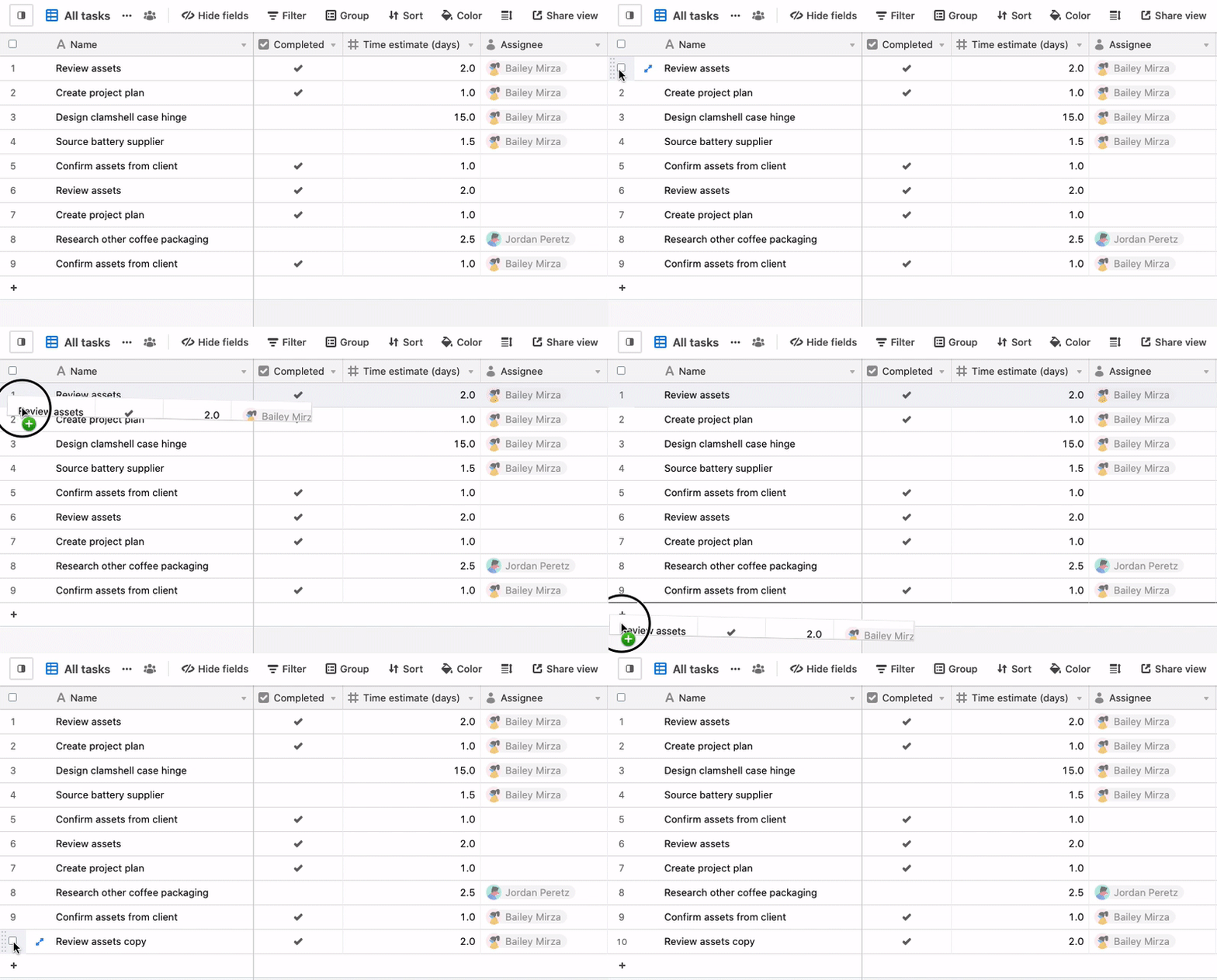
Hover over the far left portion of the record you want to move and drag it to the location of your choosing.
Keep in mind that this action may not be possible in certain views due to group or sort options that are set up.
Deleting and archiving records in Airtable
To delete a record:
Visit your Airtable home screen.
Open your preferred base.
Right-click on the record you want to delete and select Delete record.
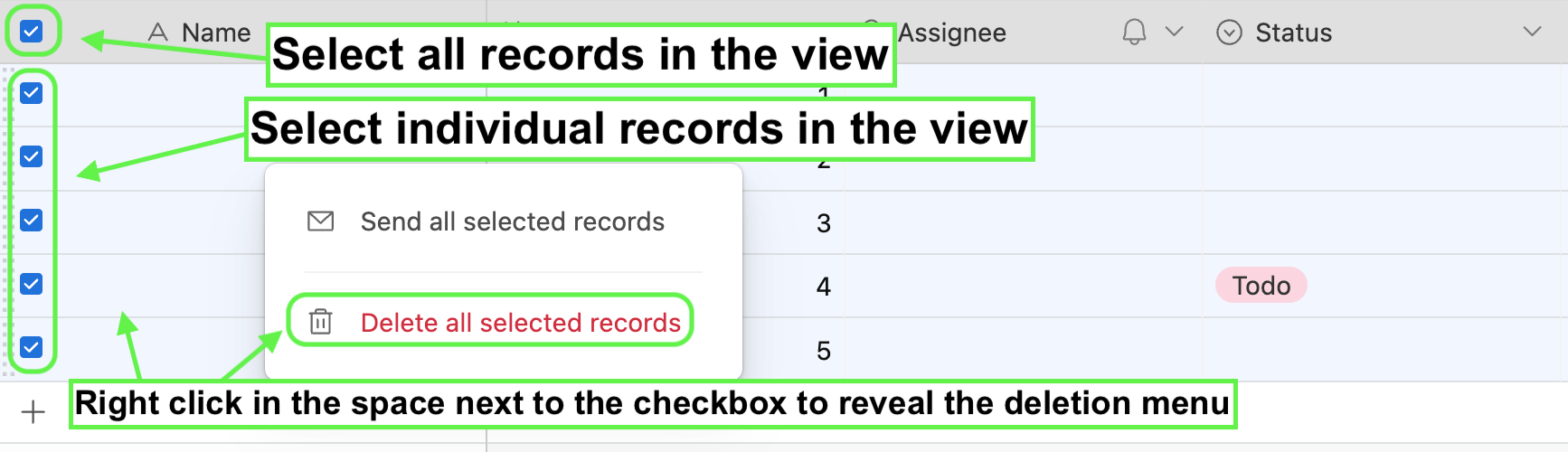
To delete multiple records simultaneously, select the checkboxes next to the records you intended to delete, then right-click and click Delete all selected records.
After deleting a record, it will temporarily be available in your workspace trash for 7 days. Learn more about base and workspace trash in our Trash for deleted bases and workspaces article.
To archive records:
Instead of deleting records, you can archive records by applying filtering conditions to your views to hide content that is no longer relevant.
Suppose any records are updated to match your archive filter criteria. In that case, those records will automatically appear in the archived records view. They will no longer be visible in any views which exclude archived records. We recommend reviewing our Advanced filtering using conditions article for more on customizing your filtering conditions with condition groups.
Keep in mind that archiving doesn’t free up record limits. We recommend checking our records limits article for additional context. To take archived records out of your record count, see "Archiving records to another base" below. We do not currently offer the ability to archive a base, but you can remove a base from your workspace by deleting it.
Archiving records to another base
Filtering records out of a view hides them, but they still count toward your base's record limit. To recover that space, copy the records into a separate archive base using Airtable Sync, confirm the copy landed, then delete the originals from your working base. This suits teams who need to keep records for a retention period but don't need them beside their working data. Airtable Sync requires a Team plan or above.
To archive records in a separate base:
Create a new base to hold your archive.
In your working base, create a grid view and filter it to the records you want to archive - for example, where "Status" is "Complete" and "Completed date" is before a cutoff you choose. Hide any fields you don't want to copy, since whatever is visible in the view is what arrives in the archive.
Sync that view into your archive base. Learn more about setting this up in our Getting started with Airtable sync article.
When the sync configuration asks how to handle records that are deleted or hidden in the source, select Leave the records in this table.
This setting is what keeps your archive intact. If the sync is set to Delete the records in this table, deleting a record in your working base removes it from the archive as well, and deleted records can't be recovered once they leave the trash. Select Leave the records in this table, or convert the synced table to an unsynced table, before you delete anything from the working base.
Confirm that the records have arrived in the archive base.
In your working base, delete the original records. To keep doing this as new records age out, use the Airtable automation action: Delete record.
If an archive base approaches its own record limit, create a second archive base and sync to that one instead. Your working base is unaffected, and collaborators see no change. You can share the archive base with whoever needs to reference historical records, independently of who can see the working base.
FAQs
How many records are in my base?
To find the number of records in a base:
Open your Airtable account overview.
Select the workspace hosting the base with the records you want to confirm from the "Workspace settings" menu.
Click Usage.
The “Usage” section details usage for automations, credits, records, and attachments for workspaces and bases.
What is the best way to duplicate a record multiple times?
Records can be duplicated using the fill handle.
Why are my duplicated records missing fields, causing them to be removed from their original groupings or filtered out of views?
If the original view's grouping field has edit-restricted permissions enabled, non-authorized collaborators cannot copy its value when duplicating, causing missing values and regrouping. To resolve, contact the base Owner and request that those permissions be turned off.
Is it possible to merge records?
We recommend using the dedupe extension or this delete duplicates script to merge, delete, and duplicate records.
Can I automate record creation or duplication?
Yes, you can use the “Create record” action in an automation to create records based on certain conditions determined by the automation trigger or automation logic.
Can I programmatically delete records in Airtable?
At this time, there are two ways to programmatically delete one or more records in Airtable:
For even more complex logic, consider using https://airtable.com/developers/scripting/api/table#delete-record-async or https://airtable.com/developers/scripting/api/table#delete-records-async to delete the record(s) via API.
How do I rename a table?
To rename a table:
Click the arrow next to your table's name.
Click Rename table and enter your preferred name.
Under “What should each record be called?” click the down arrow to select an updated name.
How do I copy record values to another table?
Though you could choose to manually copy record values from one table to a record in another table, often there are better options to use in Airtable depending on your use case:
Linked records with lookups - By connecting one table to another table in the same base via a linked record field, you can then utilize lookup fields to be able to see relevant information in both tables.
Airtable sync - This option is useful when you want all or some of the information in a table from an origin base to be reflected in another base as a synced table. Learn more about using the sync feature here.
Automations - Sometimes, it may also make sense for you to configure an automation that will create a record in another table based on information from one or more tables in that same base. It’s worth noting that this isn’t always the best choice as this can create inconsistencies across tables over time, when information is changed.
If you do need to move the values themselves — for example, when you're consolidating two tables into one — copy and paste them:
Open the source table and create a new grid view to work in, so you don't change how anyone else sees the data.
Click Hide fields and hide every field that doesn't exist on the destination table.
Drag the remaining fields into the same order as the fields on the destination table. You can drag them from the "Hide fields" menu using the 6-dot handle, which is easier when there are a lot of fields.
Select the records you want to copy, then press Cmd+C (Mac) or Ctrl+C (Windows).
Open the destination table and click the + icon to add a blank record.
Click the first cell of that record once. Make sure there's no flashing cursor in the cell — if there is, click outside the cell and click it once more.
Press Cmd+V (Mac) or Ctrl+V (Windows). If you're pasting more records than the table has room for, click Continue when asked to expand the table.
Pasting matches fields by position, not by name. The first field you copied goes into the first field you paste into, whatever the two fields are called. If the order doesn't match, values land in the wrong fields, so check the field order in both tables before you paste, and paste a few records first to confirm they landed correctly before doing the rest.
What is the character limit when copying and pasting content into records?
Copy and pasting is limited to 100,000 characters per record, including spaces between words and numbers.
How do I resolve the "Duplicate request already completed successfully" error?
When pasting large amounts of data, we suggest breaking records into smaller batches to reduce the chance of encountering this error and make recovery easier if something goes wrong.
If you see the message "Duplicate request already completed successfully" after pasting a large number of records, your records were saved. This message means Airtable detected a duplicate submission of the same request and blocked a second write to prevent creating duplicate data.
To resolve the "Duplicate request already completed successfully" error :
Refresh the Airtable base giving you the error.
Verify your records appear in the view.
If records are missing, undo (Cmd+Z / Ctrl+Z) and try pasting in smaller batches (200–300 records at a time).
Why am I receiving the error "An error has occurred. No response received," and how can I fix it?
Pasting into a linked record field is much more processing-intensive than pasting into a text or number field. For each pasted value, Airtable has to match it against existing records in the linked table (by their primary field value) and create new linked records where there's no match — so a very large paste (tens of thousands of values) can exceed the request time limit and return a generic "No response received" timeout, even though the same number of values pastes instantly into a plain text or number field (which needs no matching). This is about the volume into a linked field, not your browser or network. The fix is to paste in smaller batches — around 1,000 values at a time is a reliable batch size. If a 1,000-row batch succeeds but a larger one fails, reduce the batch size further.
How does downgrading to a Free plan impact records and data?
Your records and base data are preserved when you downgrade from a paid to a Free plan.
If your base exceeds the Free plan record 1,000 records per base limit, you can read existing records but cannot add new ones until you are within the limit or upgrade to a paid plan.